



Yesterday was a crazy day. Major rain storms. Tornado warnings. Our friends’ basement flooded. Our two year old got into a safety-locked container of oil-based paint and “painted” herself and the interior of our silver Camry green. (Don’t ask how that happened.)
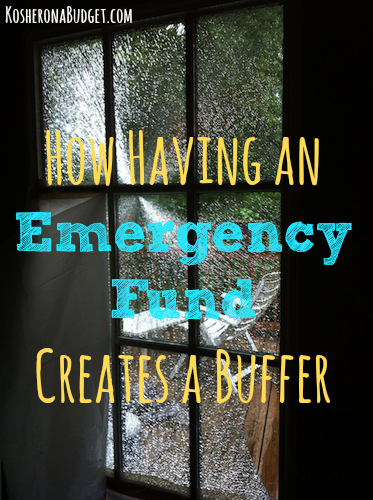
While she was wrecking havoc out in our car, our six year old was doing damage inside. He swung open the back door from our deck into our house a little too hard. The French door’s glass pane slammed it into the corner of our brick fireplace, splintering the inner pane into a bajillion pieces.
Given the torrential downfalls we were experiencing, the only good news was that the door’s glass was double-paned and the outer pane was somehow spared. This thankfully meant we didn’t end up with a living room full of water.
Meanwhile, the door’s pane has been taped up with a bunch of plastic garbage bags and cardboard boxes. It’s looking good!
As for our next steps, well we’re not sure. Fortunately we have a bit of money in our home improvement fund (remember, we discussed how we put 1/12th of 1% of our home’s value into this fund every month) – and if we tap that out, we always have our emergency fund.
That said, we are extremely loathe to use our emergency fund. We worked really hard to save up all that money – which means we are extremely motivated to not have to save it up again.
If we find ourselves in a situation that makes us consider dipping into our emergency fund, we always make double and then triple sure that (a) we really need to spend that money NOW and (b) we can’t figure out any other way to pay for it.
A killer sale on a new pair of shoes is definitely not an emergency. But what about home repairs?
Is repairing or replacing our backdoor an emergency?
Before we spend a few hundred (or thousand) dollars for new doors, we are going to do our research:
- Can we come up with a temporary fix?
- One that we can cash flow?
- If we still decide we want to REPLACE the door, can we come up with a stop-gap measure so we have take to save up the money – thus leaving our emergency fund in tact.
A similar situation happened to us over Passover. Our oven’s heating element blew up – literally. I happened to peek in and notice blue and read sparks – like fireworks – flying out of the bottom element. We turned off and unplugged that oven FAST.
After my heart stopped pounding, my next thought was, sheesh – there goes $1000 for a new oven.
Fortunately some Googling and YouTubing convinced me that it was more than likely our heating element. Rather than calling a service technician, we ordered a replacement part and my husband followed a video tutorial to install it. It worked!
We saved a fortune – not just on a new oven, but also on bringing out a repair technician. The $60 part was cash-flow-able, so we never even had to tap our emergency fund.
Developing the self-discipline to save up our emergency fund – and believe me, it didn’t come naturally; we had to overcome a lot of bad habits! – taught us a new level of resourcefulness.
Before our Emergency Fund, our first instinct in almost all situations would have been BUY IT NEW! BUY IT NOW! FIGURE OUT HOW TO PAY FOR IT LATER!
This instinct got us into a world of consumer debt trouble.
They all seemed like totally justifiable expenses – I mean, after all, you can’t live without shoes, a back door, a working oven… or whatever the “emergency” was at the time.
But now that we have scrimped and sacrificed to build that emergency fund, our instincts have changed. Sure, we still have the knee-jerk BUY NEW – BUY NOW reaction, but then we dial it back with a dose of resourcefulness and contingency planning. Before whipping out the credit card.
Does having an emergency fund protect us from the financial hit of every emergency?
Unfortunately, no. There’s no amount of money that can insulate us from every possible life crises.
But we have discovered that the discipline required to save that fund creates as much of a buffer as the money itself.
I’d love to hear about your experiences with emergency funds. Have you also found that saving up for one gave you a new sense of discipline? Do you struggle with the question “Is this really an emergency?” when it comes to drawing out funds?


Great post Mara – our emergency fund made me feel sooooo much better when our a/c went out last week (it’s already hot down here in Alabama. . .) Thankfully it wasn’t a major expense, but still having that fund helped so much.
And oh my goodness, I sure hope your Monday looks better… I thought my five year old painting her eyebrows with fingernail polish was bad but the inside of the car (and herself!!!) with oil paint is just awful. Hang in there! 🙂
It’s so funny because my boys were never as destructive as she is. She’s little, but she packs a REAL punch. Of course, now that the boys are bigger, they break stuff all the time. It’s fun around here 😉 Glad your a/c is fixed. That is one thing I could.not live without!
Thanks Mara! Looking forward to Part II
Hope you didn’t mind me taking inspiration!
Great post! I like hearing about my fellow frugalistas. I’m very stingy with the emergency fund; I like knowing it’s there–and I want it to stay there.